



Why Lead Screws are the Best Fit for Many Linear Motion Applications - and How to Rightly Apply Them
Robert Lipsett, Engineering Manager Thomson BSA Thomson Industries, Inc.
www.thomsonlinear.com sales.europe@thomsonlinear.com
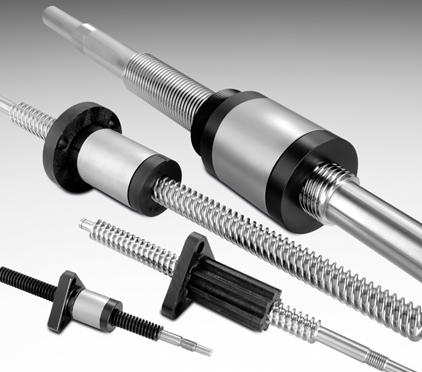
Thomson BSA lead screws.
Ball screws are often viewed as the first choice for linear motion applications because the use of recirculating ball bearings provides a high level of efficiency, load capacity, and positioning accuracy. However, with careful attention to selection and application, lead screws can deliver efficiency that comes close to ball screws on many applications, high levels of load capacity, and very good positioning accuracy while providing a better fit for the application. Lead screws offer advantages such as more flexible configuration and form factor, the ability to operate without lubricant, quieter operation, clean materials, and lower cost. Determining whether a particular application is a good fit for lead screws, and selecting the right lead screw for the application can be accomplished in a few simple steps.
Lead screws use the helix angle of the thread to convert rotary motion to linear motion. The performance of a lead screw is heavily dependent on the coefficient of friction between the nut and the screw, which in turn depends upon the material used for the nut and screw. Lead screws typically use nuts made of internally lubricated plastic or bearing-grade bronze. Plastic nuts usually travel on stainless steel screws while bronze nuts often run on carbon steel screws. When bearing-grade bronze nuts are used, stainless steel screws are an option.
Load capacity
In considering whether lead screws or ball screws are the best for an application, begin by looking at the required load capacity. Plastic nuts are typically used for light loads of less than 100 pounds (45 kg), although plastic nut designs for 300 pounds (135 kg) and beyond are possible. Bronze nuts, on the other hand, can be used for applications in excess of several thousand pounds. Ball screws generally provide equal or better load capacity than lead screws so they are a better choice if the load requirements exceed lead screw capabilities.
Efficiency
Ball screws also offer higher levels of efficiency because rolling contact provides a lower coefficient of friction than sliding contact. The efficiency of ball screws is relatively constant and is typically better than 90%. The efficiency of lead screws, on the other hand, typically ranges from 20% to 80%. The efficiency of a lead screw is highly dependent upon its’ helix angle. Helix angle is the arctangent of the lead divided by the pitch diameter. It is the angle of advancement of the thread. As a general rule, higher helix angles mean higher efficiency. A higher helix angle is more efficient because less of the energy used to drive the lead screw goes into overcoming friction. This is because the number of times the screw must rotate to achieve the same linear displacement is reduced on a high helix screw. A disadvantage of a high helix angle is that more torque is required to turn the screw.
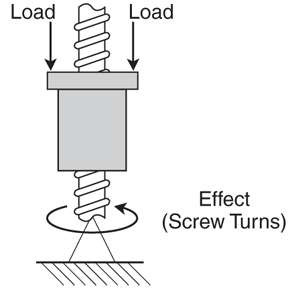
Ball bearing screws can be backdriven. A load on the nut will rotate the screw because of the inherent high efficiency (90%). If backdriving of a lead screw is required in a particular application, the lead should be greater than one third the screw diameter. Ideally the lead should be equal to or larger than the screw diameter.
It’s important to note that when the efficiency of a lead screw exceeds 50%, the lead screw becomes back-drivable, which means it can be driven backwards by the load. Back-drivability is a disadvantage in many applications because a brake may be needed to support the load if the lead screw is mounted in a vertical orientation. On the other hand, back-drivability is a plus in some applications. For example, one of the requirements of many doors in passenger rail car applications is that they can be forced open in an emergency. The application can be configured with a high-helix angle lead screw so that the doors can be closed rapidly by the motor, yet pushed open by passengers in the event of an emergency.
Speed
Ball screws are commonly available in medium leads between 5 to 20 mm per revolution, although high helix products exist. Lead screws come in a wide range of leads, from under 1 mm to 50 mm/revolution or more. The use of a wide range of leads can deliver a wide variation in jog speeds up to 180 cm per second. This lead screw feature can provide advantages in many applications. For example, devices that need to be positioned with a high level of accuracy can utilise a lead screw with a low helix angle to obtain high positioning resolution. Other applications benefit from fast jog speeds and low screw RPM, providing quiet operation and long life. The max RPM of a lead screw is limited by the critical speed of the screw (speed at which resonance occurs). Lead screw nuts can be driven at very high RPM, but depending on the load applied heat buildup may occur limiting duty cycle. Ball screws are limited by the critical speed of the screw shaft, but are also limited by how fast the balls can travel through the nut returns without damaging the components. This is known as the “DN” rating.
Duty cycle
Constant motion at load is easily provided by ball screws. Because they generate low frictional heat their duty cycle is practically unlimited. On the other hand, plastic and stainless steel lead screw assemblies are typically limited to a duty cycle of 50% under the rated load. Lead screw assemblies that use bronze nuts have higher load capacities, but these heavier loads increase frictional heat so their duty cycles must be lower, often as low as 10%. This can be calculated more accurately using the “PV” relationship (see sidebar). Lead screws can operate at 100% duty cycle at light loads and moderate speeds, or they can run at lower duty with either high load and low rpm or low load and high rpm, but not both. High load and high rpm relative to a given thread size and nut design will result in over-heating and failure.
Backlash
Backlash is another significant consideration in applications where positioning accuracy is important. Standard ball screw and lead screw configurations typically have backlash ranging from 0.02 mm to 0.25 mm. Anti-backlash lead nuts eliminate free play and increase repeatability. Most designs place a compression spring or other compliant member between two nut halves to remove radial clearance. Preload between the nut halves must equal or exceed the applied axial load in the direction in which the assembly is loaded through the take-up mechanism to prevent lost motion. The result is a higher torque requirement which typically necessitates a larger motor.
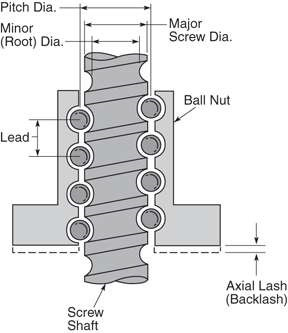
Standard ball screw and lead screw configurations typically have backlash ranging from
0.02 mm to 0.25. Anti-backlash lead nuts eliminate freeplay and increase repeatability.
A proprietary anti-backlash nut removes free play between a nut and screw without introducing excessive drag torque. Cam surfaces on a biasing spacer let it rotate and translate relative to the mating nut halves, accommodating clearances from wear of the nut threads. The angle of the cam surfaces let the two parts self-lock, preventing "ramp down" or backlash from developing under load. A torsional spring inside the cam between the half-nuts provides sufficient torque for nut biasing. Only when wear at the nut-thread interface creates clearance will the cam advance to eliminate backlash. The self-locking action prevents cam movement except during load reversals.
Noise
Ball screws are prone to a certain amount of noise because of ball bearing recirculation. On the other hand, lead screws generally produce very little noise, although frictional impedance to sliding, sometimes produces chatter or squeal in the absence of lubrication.
Corrosion resistance
Ball screws made of carbon steel, a common choice, may be sensitive to certain corrosive environments. On the other hand, lead screws with a stainless steel screw and plastic nut or are highly corrosion resistant. However, the plastic nut may be limited to temperatures between 0oC and 65o C. Lead screws with a stainless steel screw and bronze nut also provide a high level of corrosion resistance.
Design freedom and cost
Ball screws provide a relatively rigid form factor and limited design freedom. Lead screws, on the other hand, provide a higher level of design freedom. The form factor and helix angle of lead screws can be varied over a wide range, making it possible to optimise them to the requirements of most applications. Lead screws also offer a significant cost advantage. The cost of a new ball screw design is typically three to four times the cost for a new lead screw design.
Life
There is no reliable closed form solution for calculating the life of a lead screw because friction wear can be non-linear. A single wear coefficient is often insufficient to predict performance throughout the life of a lead screw assembly. Life is estimated by case study under controlled operating conditions. In the case where the combination of loading, speed and duty cycle exceeds a certain limit, failure is predictable and will occur rapidly. For applications that operate near the recommended design load at greater than 500 rpm, check with the applications engineering department of your lead screw supplier. They can calculate the pressure velocity (PV) factor, which is a key design factor in proper sizing and selection of lead screw assemblies that use polymer nuts.
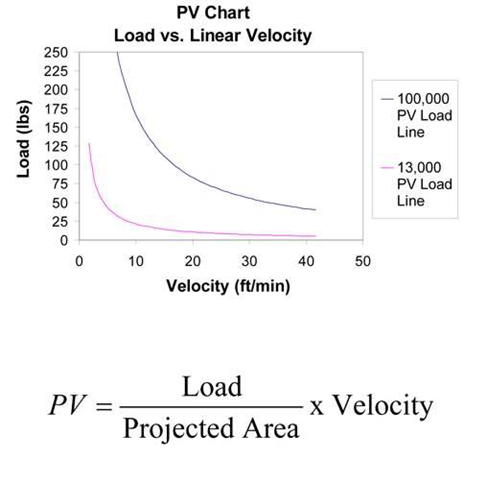
The pressure velocity (PV) factor is the product of the pressure and velocity between the
nut and screw. It helps determine the load, speed and duty cycle that the nut can handle. Plastic materials have an intrinsic PV rating, the point at which frictional heat causes permanent deformation of the plastic.
Pressure-Velocity
The previously referenced PV factor is the product of the pressure and velocity between the nut and screw. It helps determine the load, speed and duty cycle that the nut can handle. Plastic materials have an intrinsic PV rating, the point at which frictional heat causes permanent deformation of the plastic. So the more load applied to a lead screw assembly, the slower it must be turned to avoid exceeding the nuts PV limit. Likewise, the faster the nut is turned, the lower the available load capacity. The primary modes of failure for plastic nuts are wear and PV. By designing within the PV envelope, failure occurs as a result of wear. Wear failure occurs more slowly than a PV failure and can be accounted for through application of case studies and testing.
Lubrication
Lubrication is always required in order to provide a reasonable life for ball screws. Lead screw mechanisms using bronze nuts also need a lubricant, usually a thick damping grease. Lead screw assemblies with plastic nuts can run well without lubricant due to the internal lubricants in the nut material, but the use of a gel type lubricant will help increase allowable loading and extend life by reducing friction between the nut and screw. For moderate loading, speed and duty cycle in an office environment, lubrication should last between 500K and 2,500K inches. Harsh environments will reduce the grease life. If particulate is present, the screw should be cleaned before re-applying lubricant. Re-apply when there is no visible film remaining on the flanks of the screw thread.
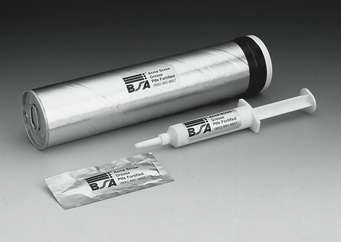
Thomson offers a full complement of lubricants for particular application needs, including low vapor pressure greases for clean room and vacuum applications. The TriGel line is specifically formulated to offer a lubrication solution for a wide range of linear motion applications.
Grease should not be used in environments with significant particulate or debris that can load the grease and cause it to become an abrasive slurry. In this type of application, dry film lubricant should be used instead. PTFE coating is a dry film that creates a lubrication barrier between a metal substrate and a polymer bushing or lead nut. It is well suited for use with plastic nuts and stainless steel lead screws. Lubrication maintenance intervals can be eliminated and the coating does not attract particulate like a gel lubricant.
Online selection and sizing
A new approach greatly reduces the time required to utilise economical and proven standard lead screws and other components to meet the vast majority of linear motion requirements. Online tools can now dramatically reduce the time it takes to identify a suitable product for a specific application. One example is Linear for Ball and Lead Screws (www.linearmotioneering.com/screws) from Thomson.
The user enters the key parameters of the application including mounting configuration, loading conditions, life requirement, orientation, speed and stroke. These requirements are filtered through a comprehensive set of calculations. The application then presents a listing of products that meet the application requirements ranked by smallest to largest screw size. These results can be further filtered on various parameters such as accuracy, repeatability, environment and nut style. Outputs include product specifications, dimensions, 3D models, quote request form and ordering information.
Solution
Lead screws provide a versatile and economical linear motion solution. Lead screws have relatively straight-forward geometry and performance and offer the flexibility to be adapted to the needs of most applications. While there are many applications that require the high stiffness, thrust capacity, and absolute accuracy of ball screws, in many cases lead screws can be engineered to meet performance requirements and provide advantages over a ball screw at a substantially lower cost.
About Thomson
With more than 70 years of motion control innovation and quality, Thomson is the industry’s premier producer of Linear Ball Bushing® Bearings and Profile Rail Bearings, 60 Case® Shafting, ground and rolled Ball Screws, Linear Actuators, Gearheads, Clutches, Brakes, Linear Systems, and related accessories. Thomson invented the Linear Ball Bushing Bearing in 1945, and has set the standard ever since with an unsurpassed set of mechanical motion control solutions serving global commercial markets. Thomson Industries, Inc. has manufacturing facilities in North America, Europe and Asia with over 2000 distributor locations around the world.
Thomson Industries, Inc.
www.thomsonlinear.com;
sales.europe@thomsonlinear.com.